
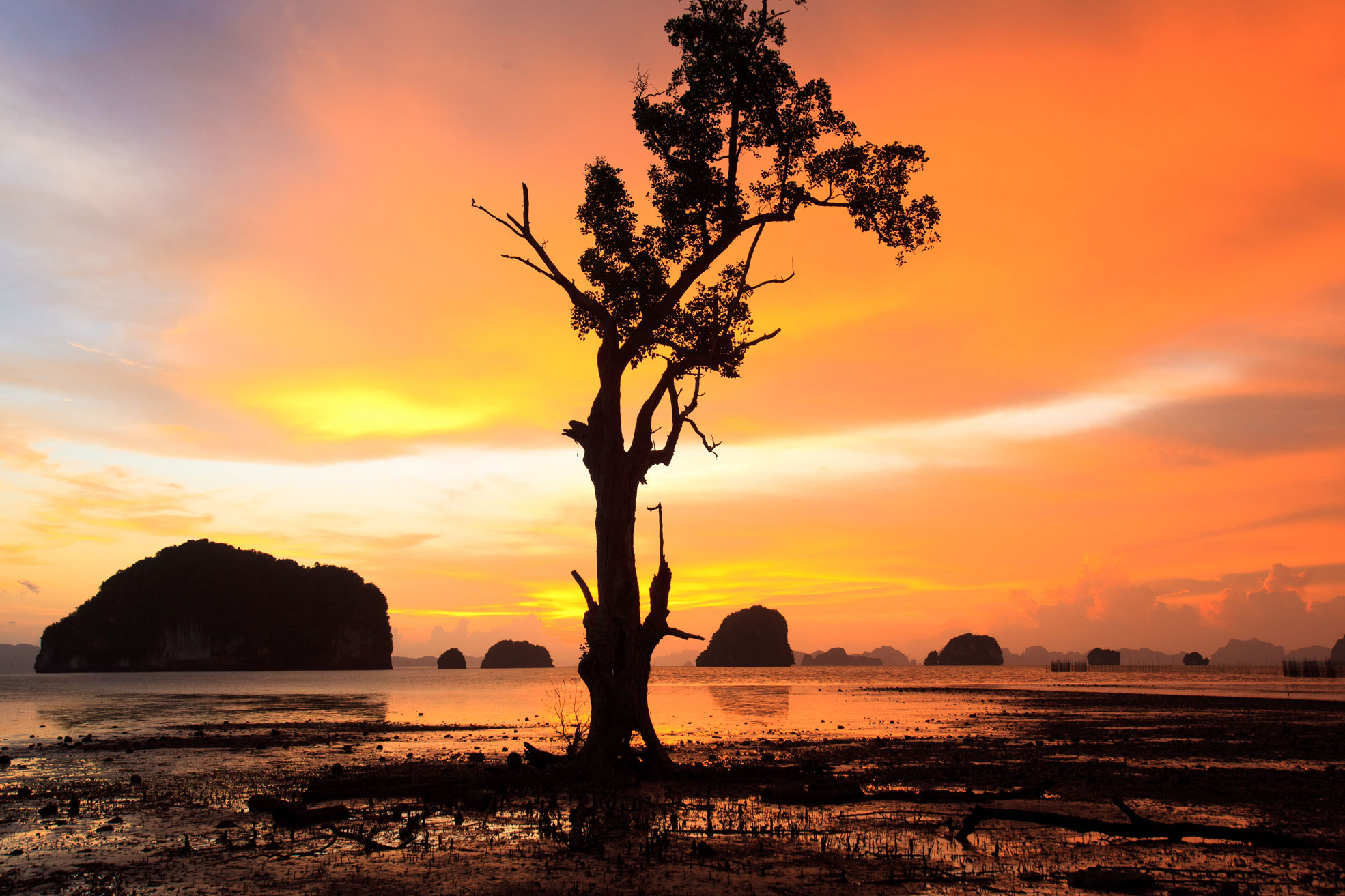
On Thailand’s Andaman coast, Krabi reveals itself slowly. This is a landscape sculpted by limestone cliffs, tidal currents, and centuries of coastal life. The sea here is vivid yet calm, the forests dense but welcoming, and the communities deeply connected to their surroundings. Krabi does not ask to be consumed quickly. It rewards those who linger, observe, and allow space for silence.
What makes Krabi distinctive is not just the beauty of its scenery, but the way nature and daily life coexist—sometimes dramatically, sometimes almost unnoticed. From iconic beaches to hidden waterways, from island villages to mineral-rich hot springs, the province offers many ways to experience Thailand at a gentler pace.


The Sea: Many Shores, Many Rhythms
For most visitors, the sea is the natural starting point. Ao Nang is the best-known coastal centre, a lively stretch of sand backed by limestone cliffs and dotted with longtail boats waiting to head offshore. Ao Nang works as a practical base: accommodations are plentiful, restaurants span local to international flavours, and boat connections make it easy to explore nearby islands. There is energy here, especially in the evenings, when the beach glows under soft light and conversations drift across open-air cafés.
North of Ao Nang, the mood shifts. Klong Muang Beach offers a longer, quieter shoreline where resorts blend into the landscape and the sound of waves replaces background music. It is a place for long walks, early nights, and mornings defined by light rather than schedules. Even further removed is Tha Len Bay, where the coastline becomes almost meditative. Here, towering limestone formations rise straight from still water, and human presence feels minimal.
From Ao Nang, day trips lead out to the nearby islands scattered just offshore. The popular Four Islands route introduces travellers to some of Krabi’s most recognisable seascapes. Ko Poda stands as a classic image of the Andaman: white sand, shallow turquoise water, and a single limestone mass anchoring the horizon. Nearby, Talay Waek , a sand dune appears with the tides, forming a temporary walkway between islands. Its fleeting nature is part of its charm—an ever-changing reminder that the sea sets the rules here.
As the day slows, many boats turn toward Railay Beach. Though part of the mainland, Railay is enclosed by sheer cliffs and can only be reached by boat. Arrival feels like crossing into a secluded world. In the late afternoon, light softens across the sand, climbers descend from the cliffs, and the atmosphere becomes quietly romantic. Railay is internationally known for rock climbing, with routes ranging from beginner-friendly slabs to demanding overhangs. From the top, the reward is perspective: a wide, open view of sea and sky that makes the effort feel worthwhile.


Kayaking: Entering Krabi at Water Level
Beyond beaches and islands, Krabi invites exploration along its inland waters. Kayaking offers a slower, more intimate way to engage with the landscape—one where sound carries, reflections matter, and movement is deliberate.
One of the most atmospheric routes is Nong Thale, a freshwater reservoir located near Ao Nang. Encircled by limestone hills, the lake is at its most compelling early in the morning. As the sun rises, mist lifts gently from the surface, and the water mirrors the cliffs above. Paddling here feels almost suspended in time, with each stroke cutting through stillness rather than noise.
A very different experience awaits at Khlong Root, often called the Clear Water Canal. This short but remarkable route follows a narrow channel of exceptionally transparent water. Underwater plants sway visibly beneath the surface, creating a layered world of movement and light. The journey leads to natural pools where swimming is possible, and finally to the freshwater spring that feeds the canal. Looking down into the spring reveals a vivid underwater garden—one of those quiet moments that stays in memory long after the journey ends.


Ko Klang: An Island of Everyday Life
Just across the river from Krabi town lies Ko Klang, an island defined less by spectacle and more by rhythm. Though surrounded by water, Ko Klang is grounded in agriculture, fishing, and craft traditions that continue largely unchanged.
The crossing by ferry takes only minutes, yet the contrast is immediate. Motorised traffic gives way to small three-wheeled vehicles and sidecar motorbikes. Narrow roads wind past rice fields and gardens, with views opening toward mangroves and canals. Visitors can stop to see the making of miniature longtail boats—symbols of Krabi’s maritime identity—or try their hand at batik painting, a craft that blends colour, patience, and storytelling.
Ko Klang is also known for Sangyod rice, a local variety adapted to saline soil. Learning about its cultivation reveals how communities here have long worked with natural conditions rather than against them. Meals often conclude at floating fish-farm restaurants, where seafood is served fresh and simply, reinforcing the island’s close relationship with the surrounding water.


Hot Springs and the Art of Rest
Inland, the district of Klong Thom offers a different side of the province—one focused on warmth, minerals, and restoration. This area is rich in natural hot springs, making it a natural destination for those seeking physical and mental ease.
The Klong Thom Saline Hot Spring is particularly distinctive, emerging as the only natural saltwater hot spring in Thailand. Set within mangrove forest, the pools feel secluded and elemental. Nearby, the Klong Thom Hot Waterfall flows gently into warm basins, inviting unhurried soaking amid forest surroundings.
For travellers seeking deeper immersion, wellness resorts elevate the experience. Wareeruk Hot Spring and Wellness is designed around a series of steaming pools set among trees, with wellness programmes that combine water therapy, gentle movement, and mindful rest. Amataya Wellness offers a more private approach, with individual soaking pools and traditional massage treatments, allowing guests to shape their own rhythm of recovery.


Ko Lanta and the Mangroves of Tung Yee Peng
South of the mainland, Ko Lanta has built a reputation as an island for those who value space and simplicity. A single coastal road traces the western shore, revealing beach after beach—some gently social, others nearly empty. Life here moves slowly. Days are often measured not by plans, but by tides, light, and appetite.
At the southern tip of the island lies Mu Ko Lanta National Park, marked by a lighthouse overlooking twin bays. One bay curves into soft sand, the other breaks into sculpted rock. Both offer wide views of the horizon, especially striking at sunset, when the sea darkens and the sky opens.
For a quieter, more intimate experience, the mangrove community of Tung Yee Peng offers early-morning boat journeys. Local residents guide paddle boats—adapted from traditional designs—silently through the mangrove channels. With no engine, the only sounds are water, birds, and oars. The journey leads to the mouth of the canal at sunrise, followed by a simple breakfast prepared with ingredients from the community. It is a gentle reminder that meaningful travel often begins early and moves slowly.


Beneath the Surface: Diving the Andaman Sea
For those drawn below the waterline, Ko Lanta serves as a gateway to some of Thailand’s most respected dive sites. West of the island lies Mu Ko Haa, a group of five limestone islets arranged around a sheltered lagoon. Snorkellers explore the calm central waters, while scuba divers descend along walls rich with colourful soft corals.
Within Ko Haa are sites known as The Cathedral and The Chimney—cavern-like formations where light filters through wide openings, allowing divers to experience overhead environments in a controlled and accessible way. These dives combine geological drama with a sense of calm that mirrors the landscape above.
Further offshore are Hin Daeng Hin Muang, two submerged pinnacles rising from deep water. The journey is longer, but the reward is exceptional. Red and purple soft corals blanket the rock faces, giving the sites their names and placing them among the most visually striking dive locations in Thailand.

Krabi Prototype: Travel with Care
Beyond its striking landscapes, Krabi is quietly shaping a new way of thinking about tourism. Krabi Prototype is an initiative by the Tourism Authority of Thailand that positions the province as a model for sustainable tourism development. The focus is not on growth alone, but on balance—how tourism can protect nature, support local communities, and create meaningful experiences at the same time. In Krabi, sustainability is treated as a practical mindset, guiding how destinations are managed and how travellers are welcomed.
This approach is brought together under the concept of “Travel with Care.” Krabi invites travellers to experience its natural beauty, culture, and ways of life with respect for the environment, personal wellbeing, and local communities. Travel here is designed around three key ideas: Self Care, journeys that restore body and mind; Nature Care, experiences that encourage protection of the sea, forests, and ecosystems; and Culture Care, learning through local traditions and community life. Carefully selected routes, services, and experiences ensure that tourism in Krabi remains both high-quality and responsible.
Krabi Prototype also supports local operators who work in harmony with nature and promotes small actions that make a real difference. One example is the “Return Home to Hermit Crabs” project at Mu Ko Lanta National Park, which invites visitors to return unused seashells to the park so they can become new homes for hermit crabs. Simple yet meaningful, the initiative reflects Krabi’s belief that travel can be genuinely good—for the destination, for local people, and for the world we share.

Quick INFO
Krabi
By car from Bangkok, the journey takes approximately 12 hours. By air, direct flights from Bangkok reach Krabi International Airport in about 1 hour.
Ao Nang
Located 17 km from Krabi town and 25 km from Krabi International Airport. Airport shuttle buses run every 30 minutes from 08:00–20:00, with fares around 150 THB per person.
Island Trips: Ko Poda & Talay Waek
Day trips cost approximately 1,200–1,800 THB per person. Tours can be booked easily through hotel counters and tour desks in the Ao Nang area.
Railay Beach
Scheduled longtail boats depart from Ao Nang Beach Pier and Ao Nam Mao Pier. Fare is around 100 THB per trip, with a travel time of 10–20 minutes.
Rock Climbing (Railay Area)
Beginner rock-climbing courses cost approximately 1,000–1,500 THB. Several climbing schools operate around Railay Beach.
Kayaking at Nong Thale
About 10 km from Ao Nang. Kayak rental is around 300 THB per kayak. Early morning is recommended.
Contact: +66 61 280 1014
Email: tha558959@gmail.com
Facebook: www.facebook.com/kwanta152999
Kayaking at Khlong Root
Approximately 12 km from Ao Nang. Kayak rental is around 300 THB per kayak. Multiple operators are available.
Website: www.kayakklongrootviewpoint.com
Ko Klang
Accessible by local ferry from Chao Fah Pier in Krabi town. Ferry fare is 10 THB. Three-wheeled sidecar vehicles can be hired for island tours (2–3 hours), costing around 200–300 THB per vehicle.
Saline Hot Spring, Khlong Thom
Located about 50 km from Krabi town (on the route to Ko Lanta). Entrance fee is 160 THB.
Opening hours: 08:00–18:00
Map: https://maps.app.goo.gl/N52r5HkvCupyAj2t5
Khlong Thom Nuea Hot Stream Waterfall
Also about 50 km from Krabi town, on the Ko Lanta route. Entrance fee is 160 THB.
Opening hours: 08:30–18:00
Map: https://maps.app.goo.gl/8sn9S9rpbKPJzsXJ6
Wareerak Hot Spring & Wellness
Offers private outdoor hot spring pools, wellness treatments, massage, and accommodation.
Website: www.wareerak.co.th
Amataya Wellness
Provides shared and private hot spring bathing, wellness treatments, and massage services.
Facebook: https://www.facebook.com/AmatayaWellness/
Mu Ko Lanta National Park (Laem Tanod Lighthouse)
Located about 20 km from Saladan down town (Ko Lanta town). The final section of the road is steep and winding; caution is advised.
Opening hours: 08:30–17:30
Entrance fee: 200 THB
Map: https://maps.app.goo.gl/qiZgWpaFXBGVLYCa9
Boat Trip at Tung Yee Peng
Traditional paddle-boat tour to watch sunrise, including breakfast and coffee.
Cost: 1,300 THB per boat | Duration: approx. 2 hours
Facebook: www.facebook.com/tungyeepengcbtplus
Tel: +66 89 590 9173
Email: nas463@hotmail.com
Diving Trips – Mu Ko Lanta National Park Area**
Scuba diving trips to Ko Haa and Hin Daeng Hin Muang are available from Ko Lanta.
Approximate cost: 3,500 THB (2 dives).
Dive operators include:
- Nice Dive Lanta – www.nicediveclub.com
- Lanta Diver – www.lantadiver.com
- Phoenix Diver – www.phoenixdivers-kohlanta.com
Share


