
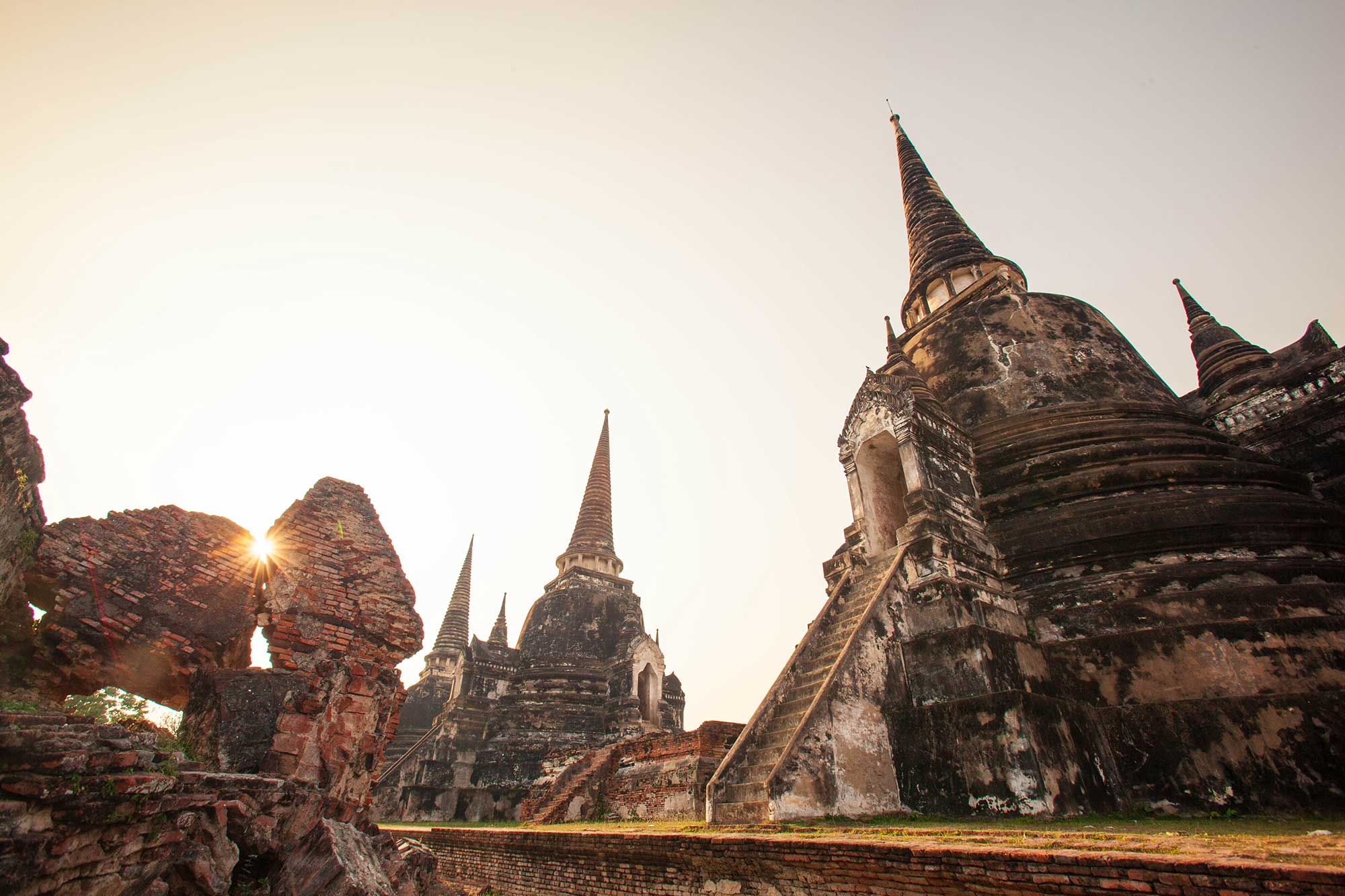
Tracing the Milestones of a 417-Year Kingdom
For 417 years, Ayutthaya stood at the heart of one of Southeast Asia’s most powerful kingdoms. Yet its long history was far from a single, continuous story. The capital passed through different dynasties and decisive turning points, absorbing ideas from earlier kingdoms, forging connections with distant lands, and repeatedly redefining its art, architecture and royal identity.
These changes can still be traced across the city. A Buddha image predating the capital, an early Khmer-influenced prang, treasures concealed within a crypt, bell-shaped stupas, international settlements and the monumental architecture of a later dynasty each represent a different chapter of Ayutthaya’s past.
Follow these places in chronological order, and a visit to Ayutthaya becomes more than a journey between ancient ruins. It becomes a journey through time—from the communities that existed before the kingdom was founded to the flourishing international capital that endured until 1767.
Before Ayutthaya — Wat Phanan Choeng
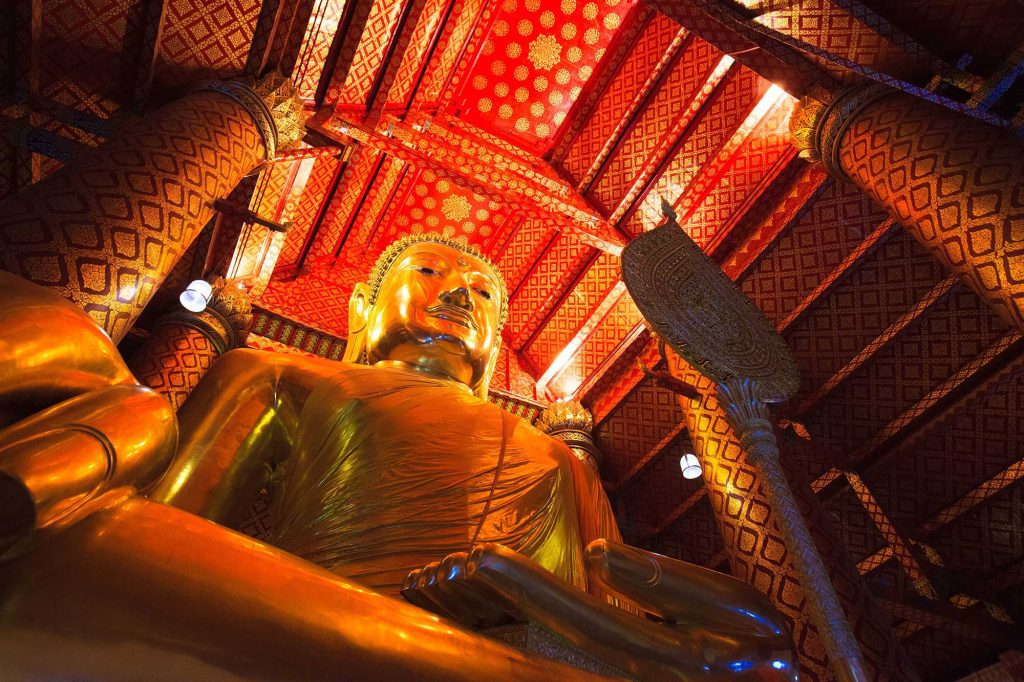
Long before Ayutthaya became a royal capital, communities were already thriving around the confluence of its rivers. The immense seated Buddha at Wat Phanan Choeng was built in 1324, twenty-six years before the kingdom was founded.
Its scale suggests that this was already an established and prosperous settlement rather than an empty landscape awaiting the arrival of a new city. The temple later developed close ties with Chinese merchants and the surrounding Chinese community, reflecting the commercial character that would continue to shape Ayutthaya for centuries.
Unlike many of Ayutthaya’s monuments, Wat Phanan Choeng is not merely a ruin from the past. It remains a living temple, where local people and pilgrims continue to worship today. This enduring devotion reflects the continuity of the riverside communities around it—a living connection that has survived beyond the rise and fall of the ancient capital.
Further Back in Time — Wat Thammikarat
Wat Phanan Choeng reveals that a prosperous community already existed before Ayutthaya became a royal capital. Yet elsewhere in the city, another temple invites us to look even further into the world that preceded it.
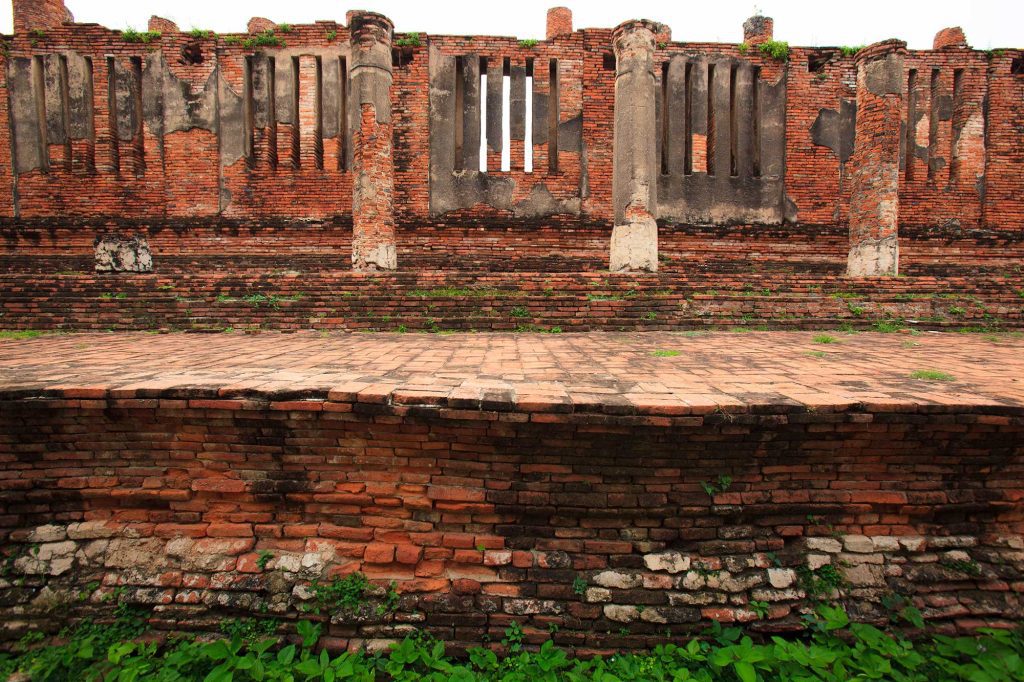
Wat Thammikarat is believed to predate the foundation of Ayutthaya. Among its most remarkable remains is the vast nine-room viharn, whose surviving brick structure still conveys the enormous scale of the original building.
The hall is thought to have once housed an exceptionally large seated Buddha image known as Phra Thammikarat, created in the artistic tradition often described as Ayodhya art, before the classical style of the Ayutthaya Kingdom fully emerged. The image itself no longer survives intact at the temple, leaving scholars to reconstruct its appearance from archaeological evidence and surviving fragments.
A colossal stone Buddha head now displayed at the Bangkok National Museum has sometimes been identified as part of Phra Thammikarat. However, its original location remains debated, and the attribution has not been conclusively established.
Even in ruins, the immense hall suggests that Wat Thammikarat was once a place of exceptional religious importance. Together with Wat Phanan Choeng, it reveals that Ayutthaya did not suddenly emerge in 1350. The royal capital grew from an older cultural landscape—one already shaped by established communities, monumental temples and its own distinctive artistic traditions.
The Early Kingdom — Wat Phra Ram
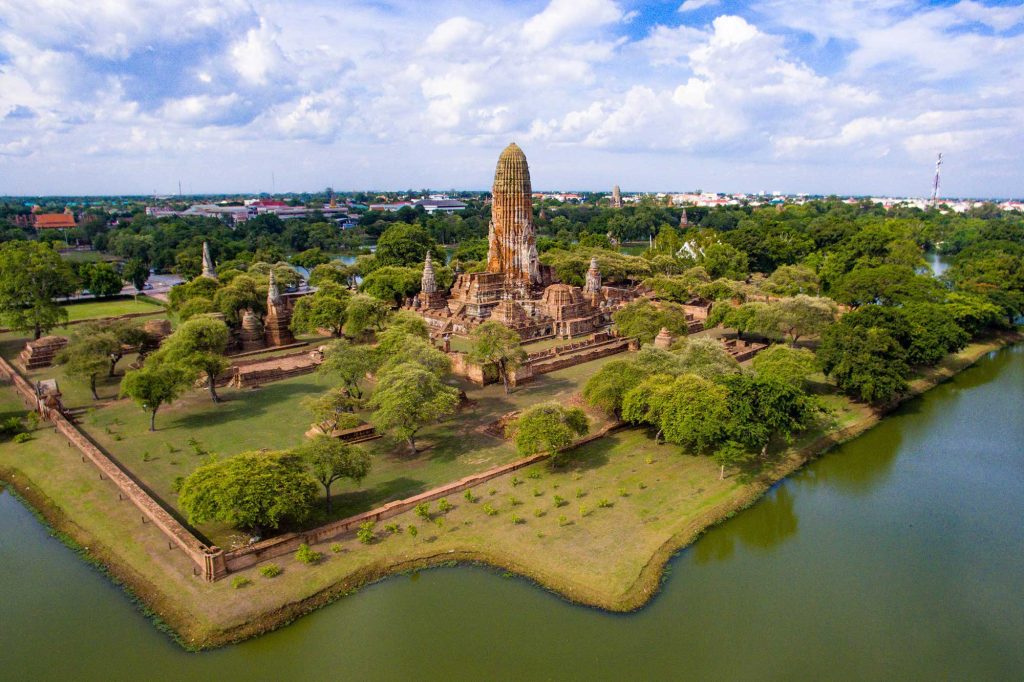
Founded during Ayutthaya’s early period, Wat Phra Ram is dominated by a towering prang inherited from ancient Khmer architecture through the cultural traditions of Lopburi.
The monument reveals how the newly established kingdom built its identity upon the artistic legacy of the states that came before it. Rather than simply copying an older form, Ayutthaya gradually reinterpreted the prang—refining its proportions and transforming it into one of the defining features of its own early architectural style.
1424 — The Golden Age Revealed at Wat Ratchaburana
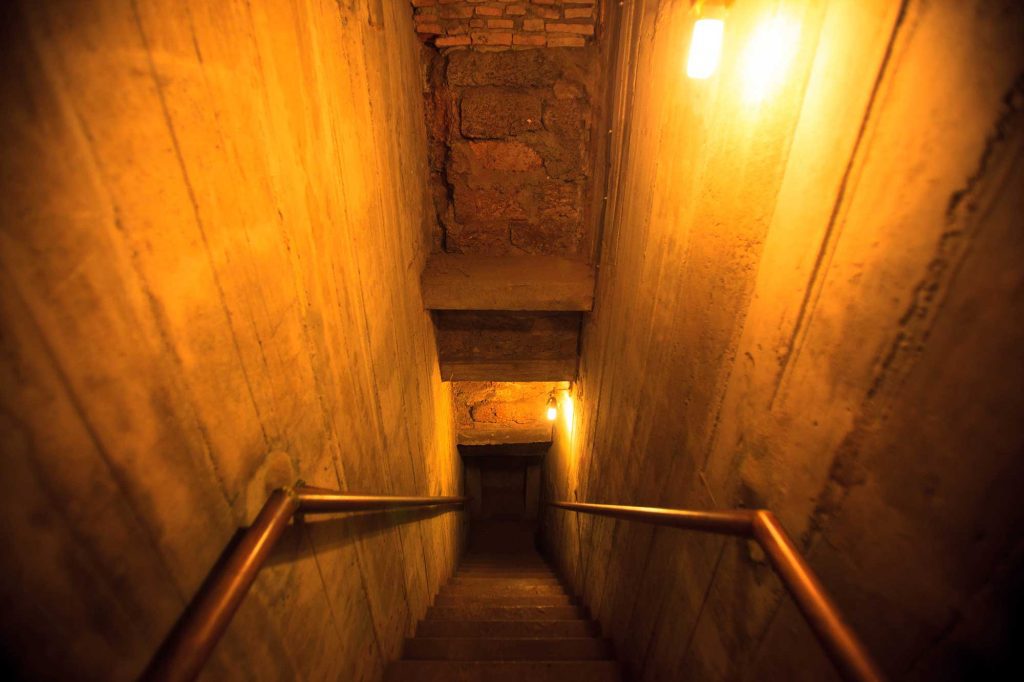
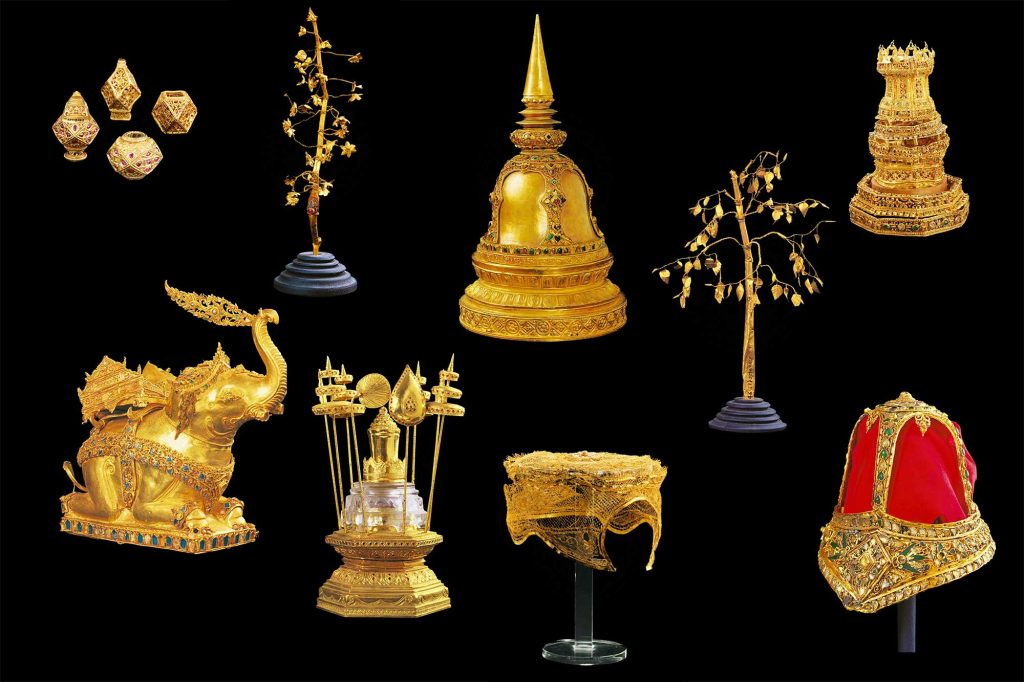
Wat Ratchaburana was founded in 1424 by King Borommarachathirat II, also known as Chao Sam Phraya. Its principal monument remained a prang, demonstrating that the Khmer-derived form still occupied a central place in royal architecture during the early 15th century.
Deep inside its crypt, extraordinary gold objects were discovered centuries later. Now displayed at the Chao Sam Phraya National Museum, these treasures reveal more than royal wealth. Their intricate craftsmanship, religious symbolism and variety of forms offer a glimpse into the sophistication of the court, the skill of Ayutthaya’s artisans and the far-reaching networks that helped enrich the kingdom.
A Buddhist Renaissance — Wat Phra Si Sanphet
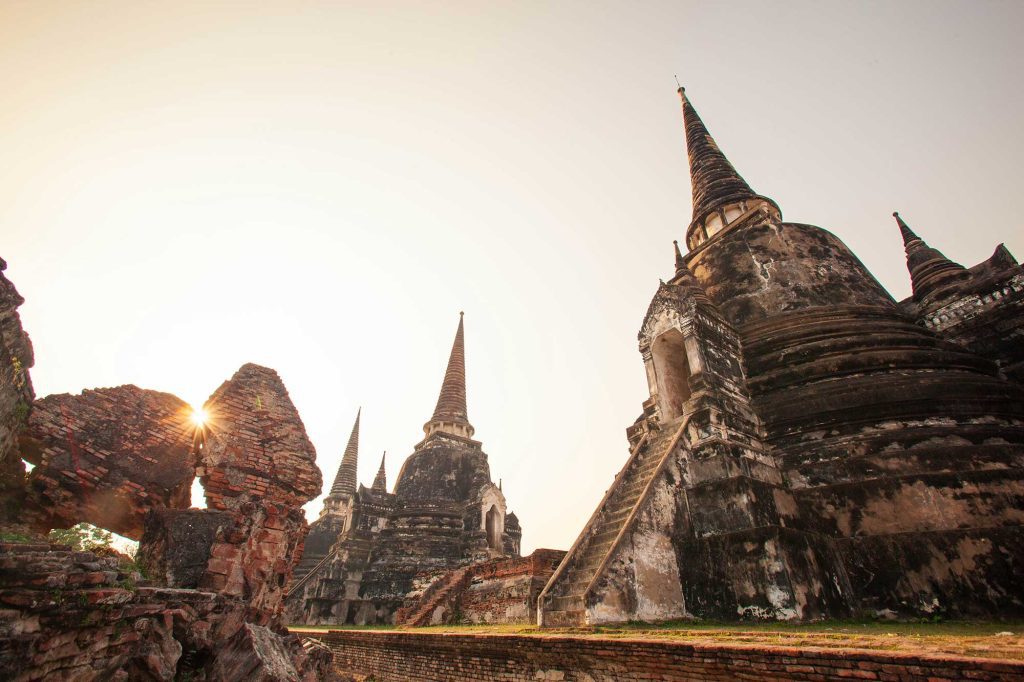
As Ayutthaya grew into a stronger and more centralised kingdom, its architectural language also began to change. Wat Phra Si Sanphet was established as the principal royal temple within the palace grounds during the reign of King Borommatrailokanat.
Its three bell-shaped stupas, built to enshrine the remains of Ayutthaya kings, reflect a Buddhist architectural tradition with roots in Sri Lanka that had already developed in Sukhothai and other parts of the region. Here, the form was elevated into a powerful symbol of the Ayutthaya court, marking a visible transition from the prang-dominated monuments of the earlier period to the bell-shaped stupa as a prominent expression of royal Buddhism.
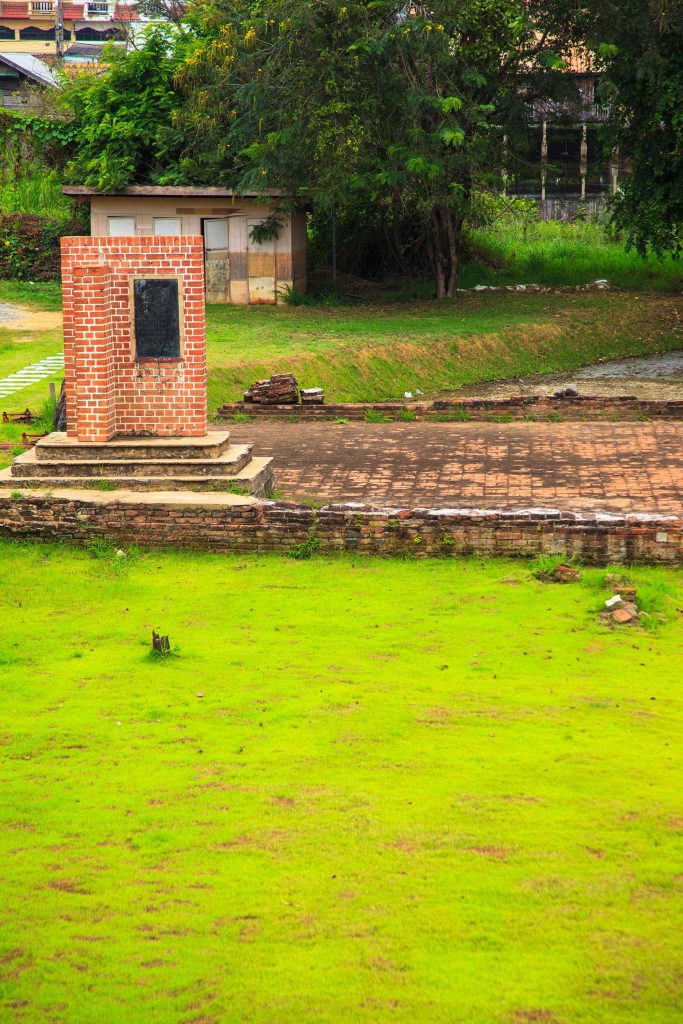
The 16th–17th Centuries — An International Capital
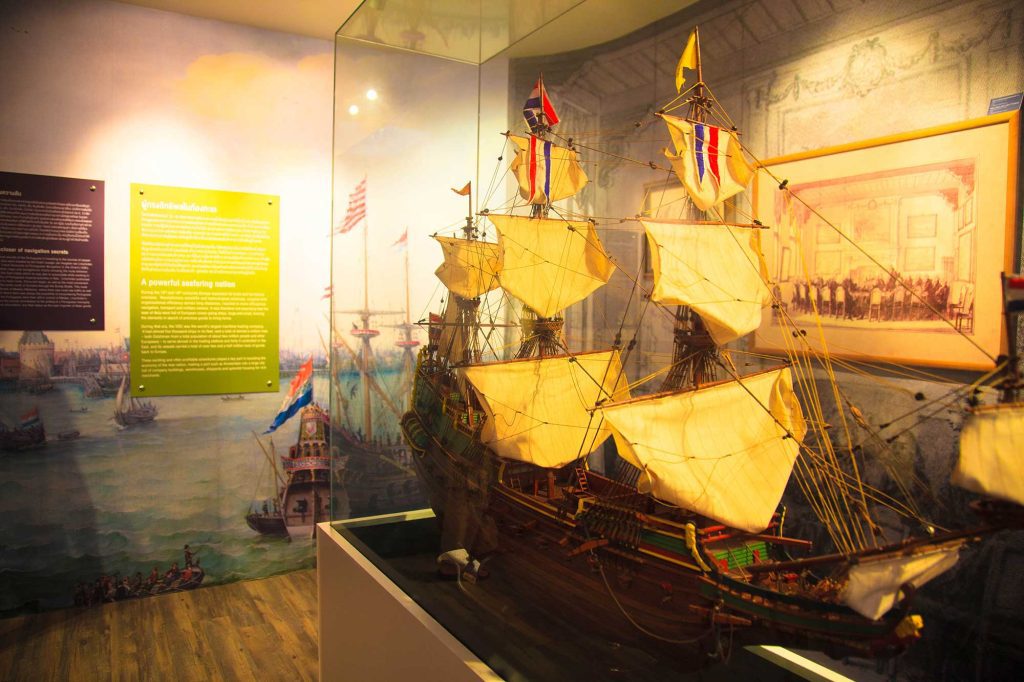
By the 16th and 17th centuries, Ayutthaya had become one of Asia’s great international trading cities. Portuguese, Japanese, Persian, Chinese and Dutch communities, among many others, settled around the capital, creating cosmopolitan quarters beyond the city walls.
The remains of the Portuguese, Japanese and Dutch settlements reveal a chapter of Ayutthaya that cannot be understood through temples alone. Goods, knowledge, technologies, beliefs and people travelled through the city, connecting Siam with ports across Asia, Europe and the wider world. Ayutthaya’s wealth did not exist in isolation—it grew from the rivers and international networks that converged here.
The Great War for Freedom — The Age of King Naresuan
In the late sixteenth century, mainland Southeast Asia was shaped by a fierce struggle between two powerful kingdoms: Ayutthaya and Hongsawadi. Both sought to expand their influence, control important territories and establish supremacy over the region.
After Ayutthaya fell to Hongsawadi in 1569, it remained under Burmese authority for more than a decade. The turning point came in 1584, when Prince Naresuan declared Ayutthaya’s independence. His decision began a long period of warfare, as Hongsawadi repeatedly sent armies to reclaim the kingdom while Ayutthaya fought to secure its freedom.
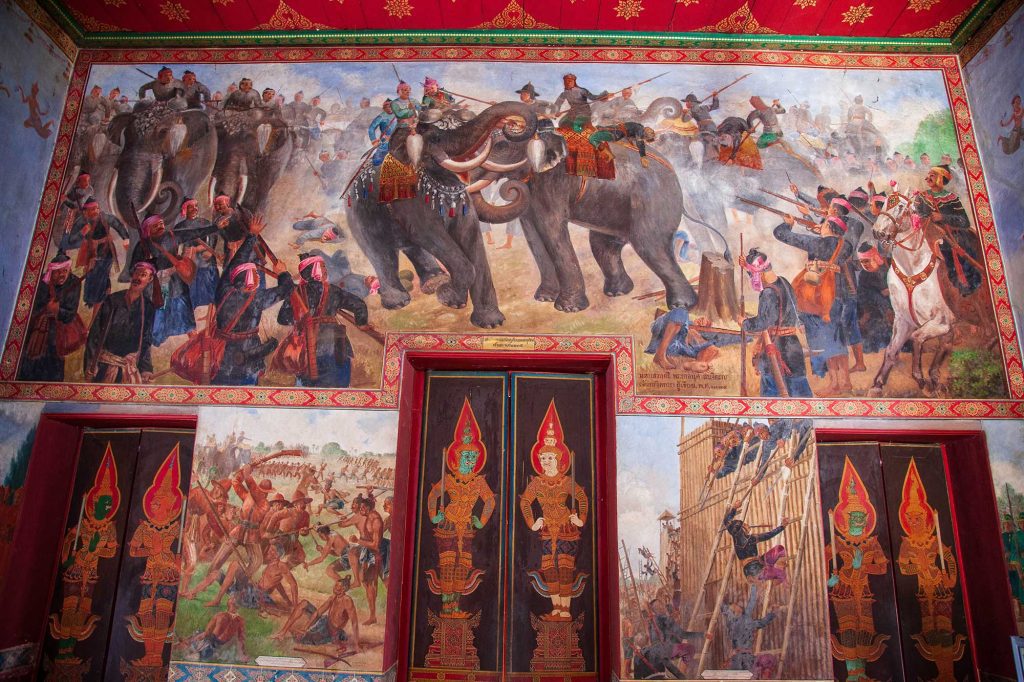
King Naresuan emerged as the central figure of this turbulent era. Through a series of military campaigns, he not only defended Ayutthaya but restored its power. The most celebrated episode came in 1593: the legendary elephant duel between King Naresuan and the Burmese crown prince. Remembered in Thai history as the Battle of Nong Sarai, it became an enduring symbol of courage, independence and the kingdom’s survival.
This dramatic moment can be seen today at Wat Suwandararam, where murals inside the viharn depict important episodes from King Naresuan’s life, including the famous elephant duel. The paintings were not created during his lifetime, however. They were painted centuries later—during the reign of King Rama VII—and reflect how later generations remembered and reimagined this great struggle for independence.
The temple itself has also undergone extensive restoration since the fall of Ayutthaya, so much of what visitors see today appears considerably newer than the city’s ancient ruins. Yet within its restored walls, the murals offer a vivid visual gateway into one of the most decisive periods in Ayutthaya’s history.
The Flourishing of Ayutthayan Art— Wat Chaiwatthanaram
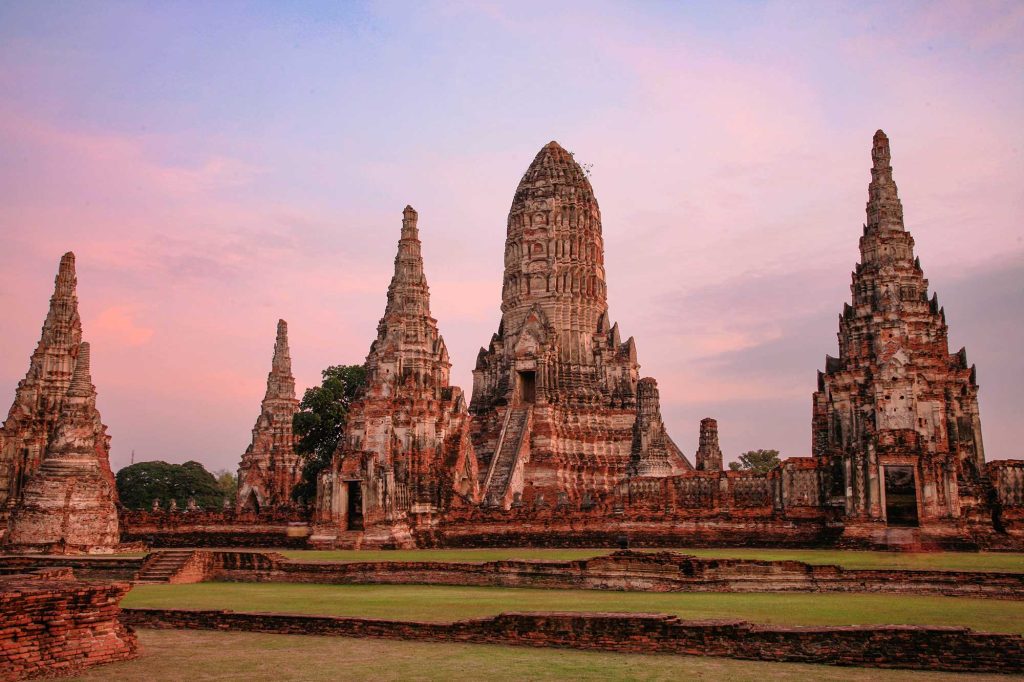
Built in 1630 during the reign of King Prasat Thong, Wat Chaiwatthanaram marked a dramatic return to the prang, but in a new and unmistakably Ayutthayan form.
The central prang rises above four smaller prangs within a carefully ordered complex representing the Buddhist cosmos, with Mount Meru at its centre. Its Khmer-inspired architecture has sometimes been associated with Ayutthaya’s military campaigns in Cambodia, although this interpretation remains debated. More clearly, the temple expressed the prestige, religious merit and royal authority of a new dynasty seeking to establish its place in Ayutthaya’s history.
Divine Kingship — The Crowned Buddha
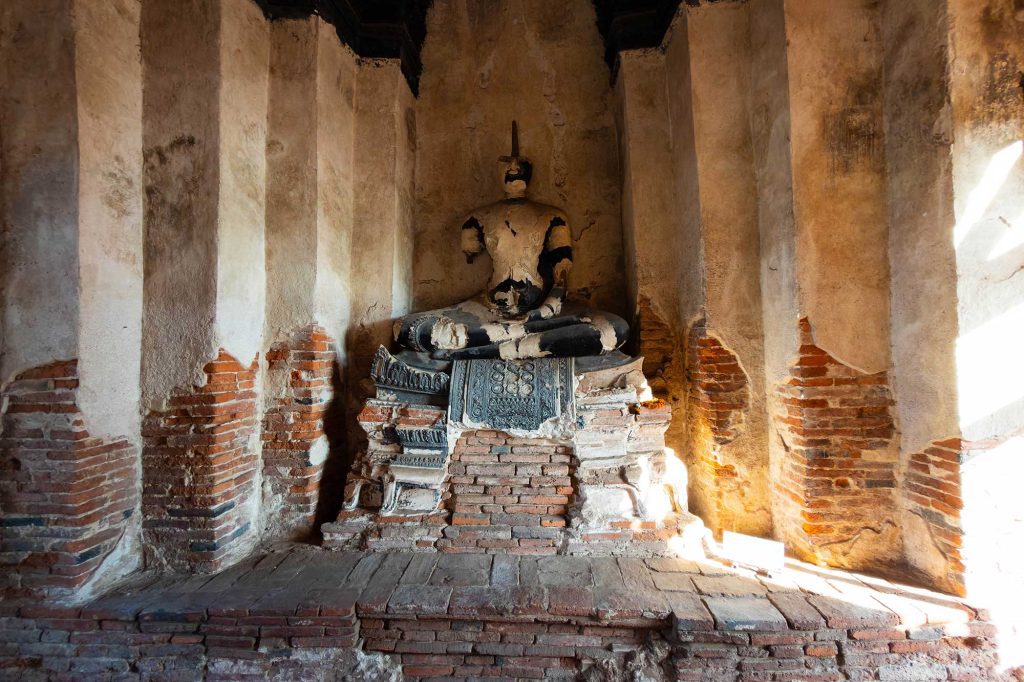
Crowned Buddha images became increasingly prominent from the middle Ayutthaya period and grew more elaborate toward the final centuries of the kingdom.
The royal ornaments do not simply depict a Buddha dressed as an earthly king. They present him as a Chakravartin—a universal sovereign and a king above all kings. These images reveal how Buddhist belief and the language of kingship became closely intertwined in the artistic world of the Ayutthaya court, giving spiritual ideas a distinctly royal form.
Together, these places and objects show that Ayutthaya was never frozen in a single style or era. It continually inherited, adapted and transformed ideas—from Lopburi and Sukhothai, from Sri Lanka and the Khmer world, and from communities arriving across distant seas. To travel through Ayutthaya today is therefore to encounter not one ancient city, but many chapters of a kingdom written across more than four centuries.
Share


