
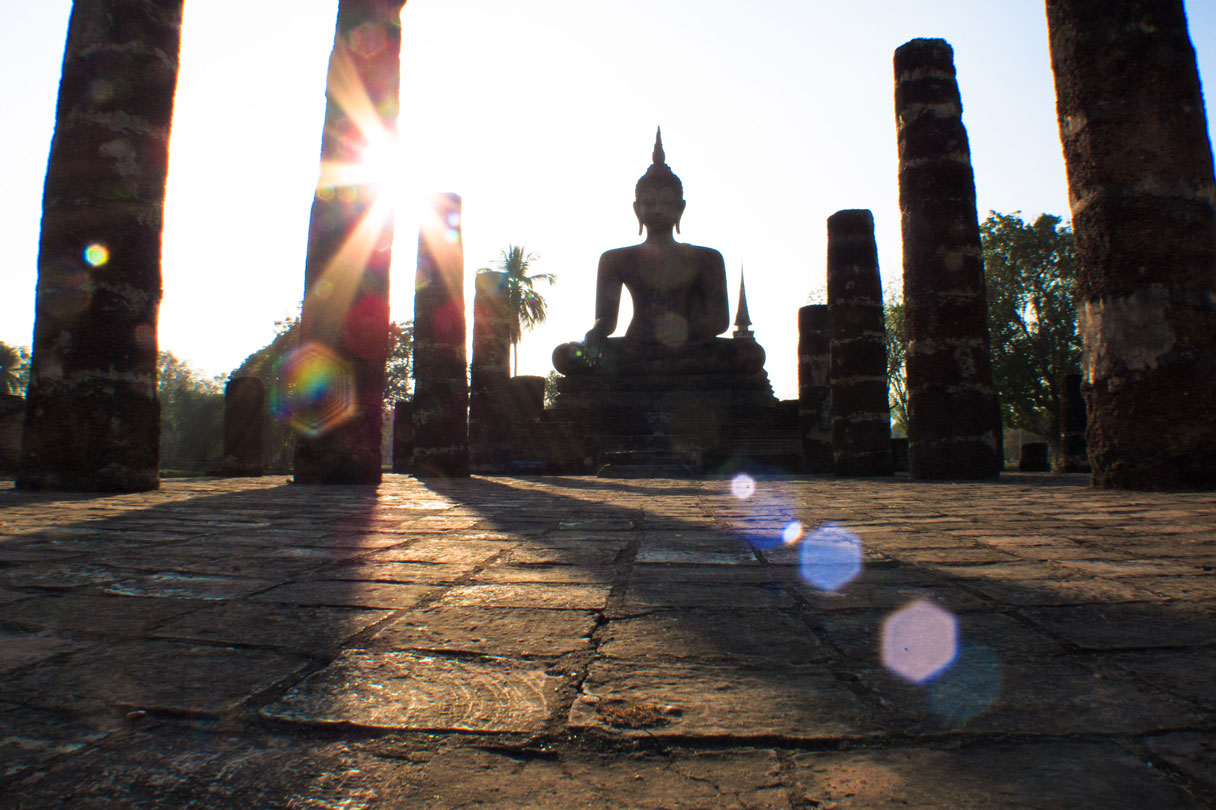
The World Heritage site of Sukhothai extends beyond a single ancient city. It encompasses Sukhothai, Si Satchanalai and Kamphaeng Phet—three historic towns united by a shared civilisation and a distinctive artistic language.
Sukhothai art absorbed ideas from earlier Khmer traditions, Theravada Buddhism from Sri Lanka and neighbouring cultures across the region. Yet its artists did more than imitate what came before. They refined these influences into something recognisably their own: graceful Buddha images, flowing lines, balanced proportions and architecture filled with spiritual meaning.
Across these three historic towns, that artistic achievement can still be encountered in many forms—from the serene face and elegant hand of a monumental Buddha to the rhythm of a walking figure, the intricate surface of ancient stucco and a procession of elephants supporting a vanished stupa.
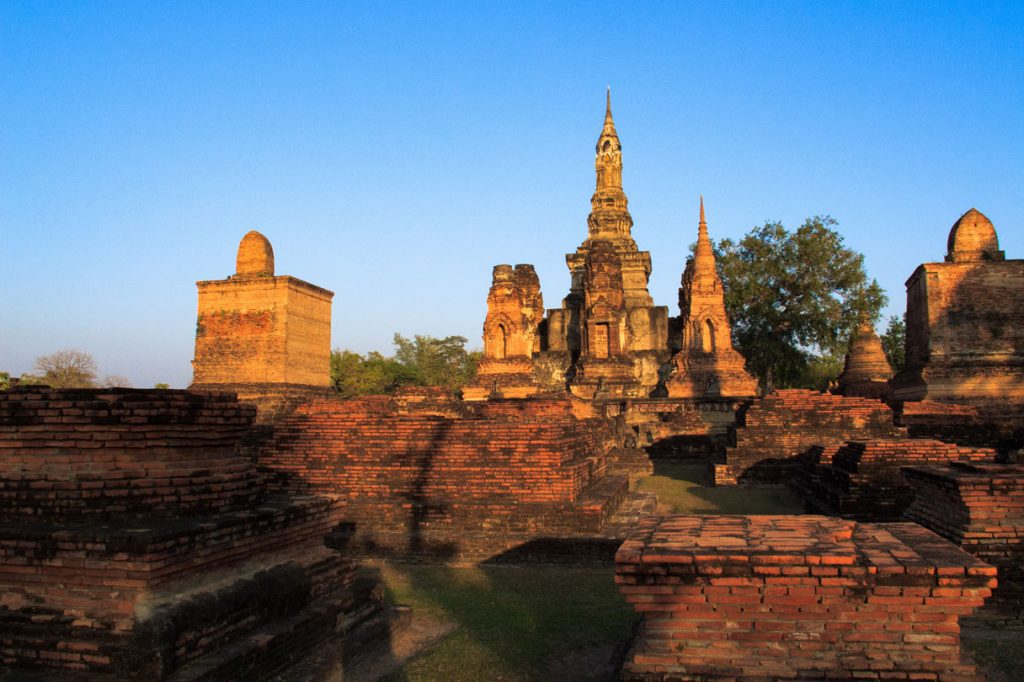
An Architecture of Many Worlds — Wat Mahathat
At the centre of ancient Sukhothai stands Wat Mahathat, the kingdom’s principal temple and one of the clearest expressions of its artistic identity.
Its central monument is crowned by a lotus-bud stupa, also known as the phum khao bin form. With its slender profile and pointed floral silhouette, it became one of the most distinctive architectural forms developed in the Sukhothai world.
Yet the monument does not stand alone. Eight smaller towers surround the principal stupa within the same sacred composition. Those positioned along the cardinal directions take the form of prasat-like stupas shaped by earlier Khmer architectural traditions, while the four corner towers display multi-spired forms associated with Mon-Hariphunchai, Pagan and early Lanna influences.
Elsewhere across the temple grounds are numerous bell-shaped stupas derived from Sri Lankan Buddhist architecture, alongside further subsidiary monuments constructed and restored over different periods.
Wat Mahathat is therefore not an expression of a single isolated style. It is a carefully ordered meeting place of artistic traditions—from Khmer architecture and the Buddhist world of Sri Lanka to the cultures of Hariphunchai, Pagan and the northern regions. At its centre, the lotus-bud stupa reveals how Sukhothai absorbed these diverse influences and transformed them into an artistic language of its own.
This diversity also reflects Sukhothai’s position within an active network of cultural exchange. Religious ideas, craftsmen and artistic forms travelled between neighbouring kingdoms and across wider Buddhist networks, connecting Sukhothai with the Khmer world, Sri Lanka, Pagan, Hariphunchai and the northern regions. The monuments of Wat Mahathat therefore reveal not an isolated kingdom, but one that grew through contact with other cultures—selecting, adapting and ultimately transforming their ideas into a distinctive artistic identity of its own.
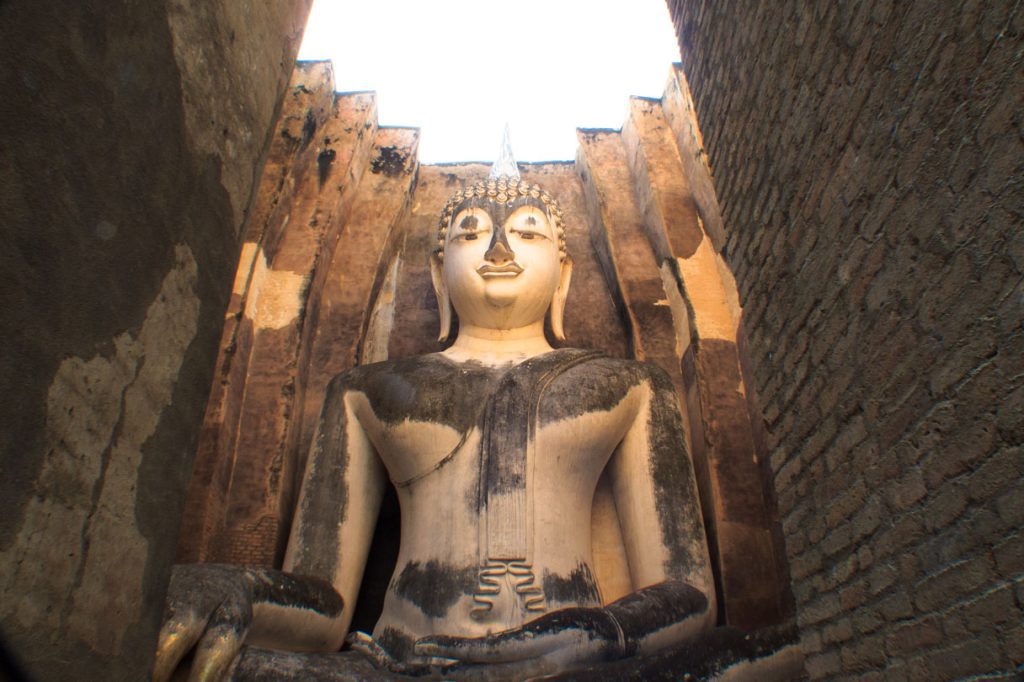
Serenity Made Visible — Phra Achana at Wat Si Chum
Enclosed within the towering walls of a monumental mondop, Phra Achana is one of the most powerful expressions of Sukhothai Buddhist art.
The immense seated Buddha nearly fills the confined interior, yet the image does not feel heavy or imposing. Its gently curved eyebrows, elongated face and restrained smile create an atmosphere of stillness, while the narrow opening of the mondop carefully frames the figure against the sky.
The name Phra Achana is commonly interpreted as “one who is unafraid” or “one who remains unmoved”—a meaning reflected in the image’s calm and steadfast presence.
Among its most admired features is the right hand descending toward the ground in the gesture of calling the earth to witness. Its long, tapering fingers are modelled with exceptional elegance, revealing the Sukhothai ideal of beauty: human in form, yet refined beyond ordinary human proportions.
At Wat Si Chum, beauty is not created through elaborate ornament. It emerges from serenity, proportion and the expressive power of a single gesture.
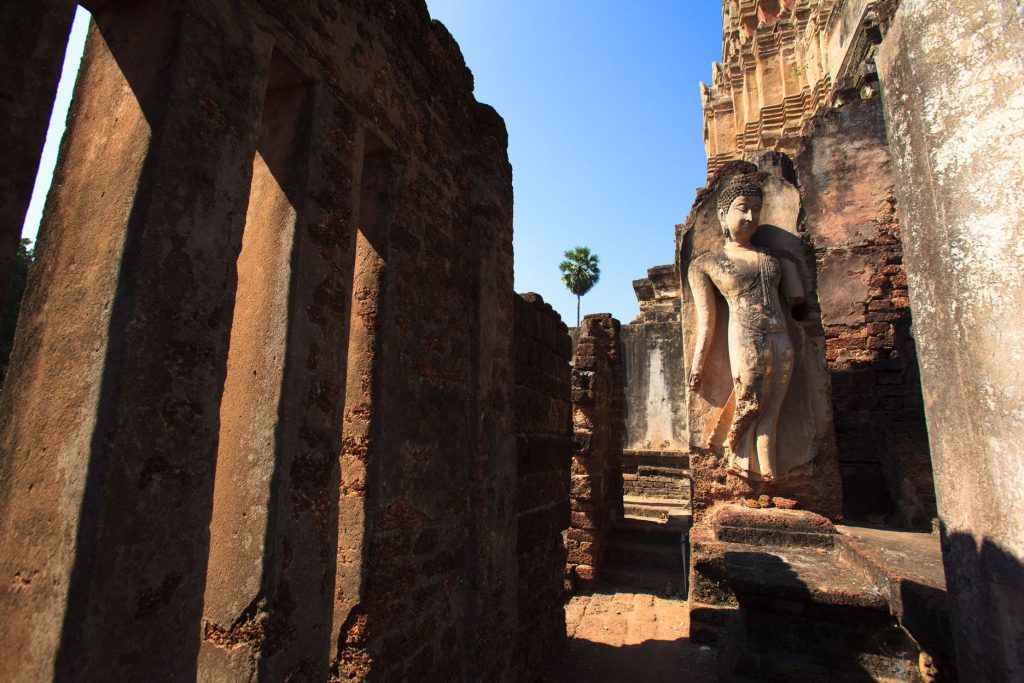
When Stillness Began to Move — Wat Phra Si Rattana Mahathat Chaliang
Few images express the character of Sukhothai art more clearly than the walking Buddha.
At Wat Phra Si Rattana Mahathat Chaliang, in Si Satchanalai, a graceful stucco Buddha in the walking posture stands near the principal image. One heel rises gently from the ground as the body moves forward, while the curved arm and flowing outline of the figure create a sense of controlled movement.
This was not simply an attempt to portray a person walking. Sukhothai artists transformed movement into a spiritual ideal. The elongated limbs, narrow waist and flowing contours make the Buddha appear weightless—as though progressing with a rhythm beyond the physical world.
The image is particularly meaningful in its setting. Wat Phra Si Rattana Mahathat Chaliang developed across several periods and contains evidence of artistic traditions predating the rise of Sukhothai. The presence of the walking Buddha therefore demonstrates how a new and distinct artistic language emerged within a much older sacred landscape.
Here, Sukhothai art appears not as a sudden invention, but as the graceful result of cultural transformation.
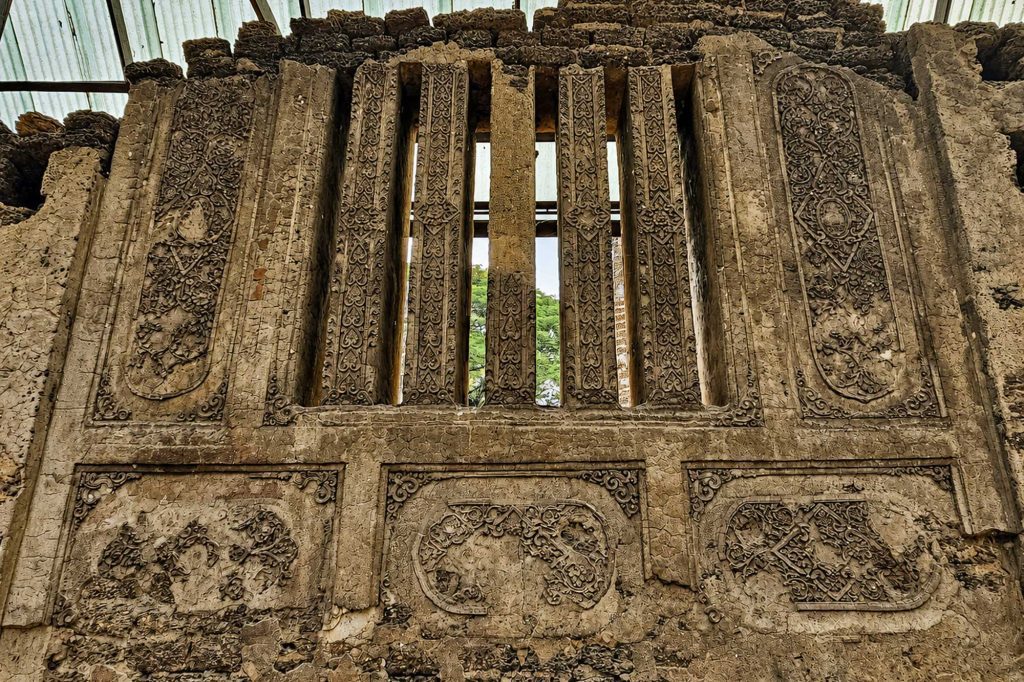
Poetry Written in Stucco — Wat Nang Phaya
The exposed brickwork seen across the historic towns can make Sukhothai architecture appear austere today. Originally, however, many of these structures were covered with smooth plaster and richly decorated stucco.
At Wat Nang Phaya in Si Satchanalai, surviving stucco reliefs offer a rare glimpse of that lost surface. Delicate vegetal scrolls, rhythmic foliage and ornamental patterns once extended across the walls of the viharn, transforming its architecture into an intricate work of decoration.
The value of these fragments lies not only in their beauty. Stucco is far more vulnerable than brick or laterite, and much of the decorative skin that once covered ancient monuments has disappeared through centuries of exposure. What remains at Wat Nang Phaya therefore provides important evidence of the technical ability, visual imagination and patient craftsmanship of its artists.
Each surviving detail reminds us that the ruins were never intended to appear as bare walls. They were once complete works of art in which architecture, sculpture and ornament were inseparable.
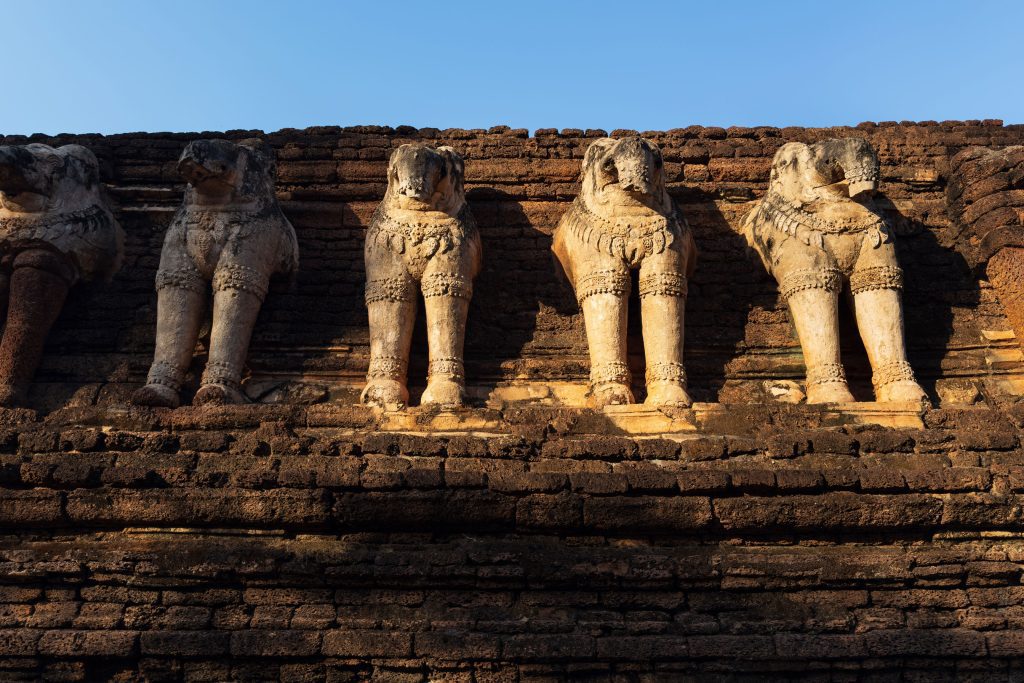
The Elephants That Still Stand — Wat Chang Rop
At Kamphaeng Phet, the forested setting and extensive use of laterite give the monuments a character distinct from those of Sukhothai and Si Satchanalai.
One of its most remarkable artistic achievements is Wat Chang Rop. The upper part of its principal bell-shaped stupa has largely disappeared, but its immense square base remains, surrounded by 68 stucco elephants projecting from the structure.
Many of the elephants retain traces of elaborate ornaments around their necks, legs and bodies. Decorative reliefs once filled the spaces between them, turning the entire base into a monumental work of sculpture.
The elephants were not arranged as decoration alone. Visually, they appear to support and protect the sacred monument above, transforming symbols of strength into part of the architecture itself. Although the stupa they once carried has been largely lost, the surviving procession preserves its scale and authority.
Wat Chang Rop demonstrates how the artists of Kamphaeng Phet developed the wider Sukhothai tradition in their own way—using powerful mass, richly adorned sculpture and the natural character of laterite to create a monument of striking physical presence.
Together, these five places reveal the breadth of Sukhothai’s artistic achievement. Its beauty can be found in the stillness of Phra Achana, the balance of the lotus-bud stupa, the flowing movement of the walking Buddha, the delicacy of ancient stucco and the strength of elephants carrying a sacred monument.
Sukhothai art was neither uniform nor isolated. It grew from the exchange of ideas across regions and generations before developing into a language of grace that became one of the foundations of Thai art.
To explore Sukhothai, Si Satchanalai and Kamphaeng Phet through these works is therefore to see more than a collection of ruins. It is to encounter a civilisation that transformed faith, movement, material and proportion into enduring beauty.
Quick Travel Information
Sukhothai Historical Park
Sukhothai is approximately 430 kilometres north of Bangkok. The fastest option is a direct flight from Suvarnabhumi Airport to Sukhothai Airport, taking around 1 hour 20 minutes. From the airport, continue by airport transfer, taxi or pre-arranged car to the historical park.
Direct coaches also depart from Bangkok’s Mo Chit Bus Terminal for Sukhothai, generally taking around 6–7 hours. Travelling by private car takes approximately six hours. There is no railway station in Sukhothai; travellers arriving by train should alight at Phitsanulok and continue by bus or car.
The monuments inside Sukhothai Historical Park are spread across a large, mostly level area. Bicycles are available for rent near the entrance and are one of the easiest and most enjoyable ways to explore the ancient city.
From Sukhothai to Si Satchanalai
Si Satchanalai Historical Park lies approximately 55–65 kilometres north of Sukhothai, depending on your starting point. The journey takes around one hour by private car or hired driver.
Local public transport is limited and may not connect conveniently with the historical park, so arranging a return transfer or renting a car is the simplest option. Si Satchanalai can be visited as a day trip from Sukhothai, although staying nearby allows more time to explore the monuments at a relaxed pace.
Kamphaeng Phet Historical Park
Kamphaeng Phet lies approximately 330–360 kilometres north of Bangkok. Direct coaches depart from Mo Chit Bus Terminal and normally take around 5–6 hours, arriving at Kamphaeng Phet Bus Terminal. By private car, follow Highway 1 through Nakhon Sawan; the journey generally takes around five hours. Kamphaeng Phet has no commercial airport or direct railway service, making bus and road travel the most practical options.
The historical park is divided into monuments within the ancient city and the forested Aranyik area outside it. As the two zones are separated, visitors arriving without a car should arrange a local taxi, tuk-tuk or hired vehicle.
Continuing from Sukhothai and Si Satchanalai to Kamphaeng Phet
From Sukhothai Historical Park, Kamphaeng Phet is approximately 80 kilometres away and takes around 1 hour 15 minutes by car. From Si Satchanalai, the journey is approximately 135–145 kilometres and takes around 2–2.5 hours, normally travelling south through Sukhothai.
A rental car or private transfer is strongly recommended for travellers combining all three World Heritage towns. Public transport between the historical parks is limited and may involve returning to Sukhothai Bus Terminal, changing vehicles or waiting for an onward service. Travellers relying on buses should therefore confirm connections locally before departure.
Flight and coach schedules may change, particularly on weekends and public holidays, so check directly with the operator before travelling. Bangkok Airways currently operates the Bangkok–Sukhothai route from Suvarnabhumi Airport.
Share


