
7 Responsible Journeys, Meaningful Experiences
Travel has evolved. It’s no longer just about the destination; it’s about the footprint we leave and the stories we carry home. In Thailand, a quiet revolution is unfolding; a shift from checking boxes to cultivating awareness.
From the emerald canopy of ancient forests to the rhythmic pulse of coastal villages, a new way of exploring is emerging. Whether it’s guiding a hatchling sea turtle to the surf, cycling through hidden local paths, or supporting a community-led livelihood, these experiences aren’t just trips; they’re acts of intention.
We invite you to slow down. To move with purpose by boat and bike. To honor ecosystems that breathe life into the land. These aren’t grand gestures; they are small, daily choices made by those who love this land.
This is Thailand, reimagined through seven responsible journeys. Discover how travel, when done with heart, becomes something more.


Sun-Powered Boat : Where the River Moves Quietly
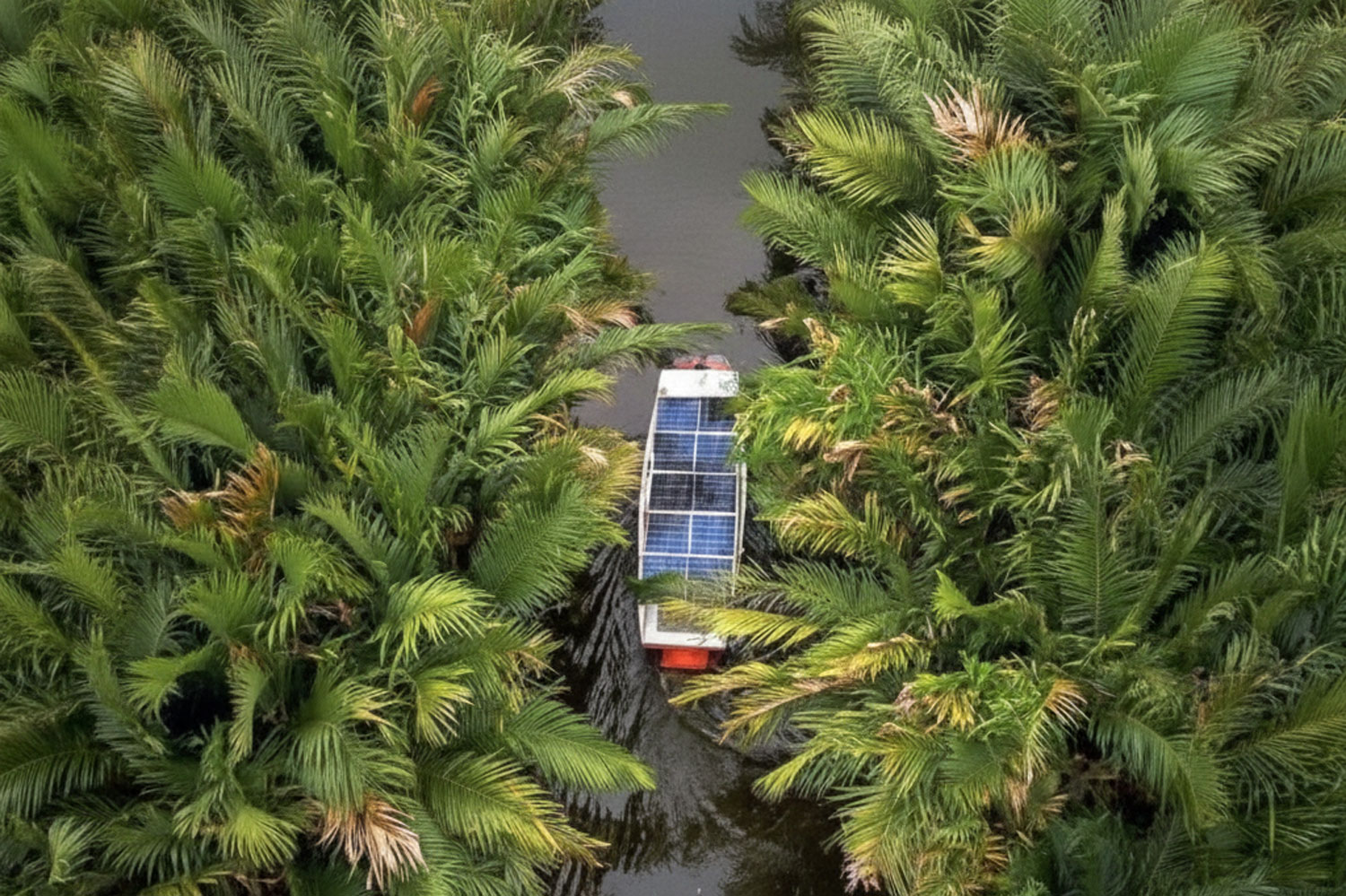
Along the waterways of Bangkok Noi Canal and Khlong Bang Luang, a different kind of journey unfolds—one that moves gently, without the sound and weight of a traditional engine.
At the heart of the experience is Suksamran, a wooden boat with a story of its own. Built around 70 years ago, it once ran on diesel like many others along the river. Today, it has been carefully restored and transformed into a solar-powered hybrid vessel—quiet, low-impact, and in harmony with the water it travels on.
If the journey begins in the early morning, the canal reveals one of its most timeless scenes—monks paddling slowly along the water to receive alms. It is a quiet ritual, unfolding naturally as the boat drifts past.
The route moves through a layered landscape—local communities, old wooden houses, and stretches of green where gardens and orchards soften the edges of the city. Along the way, there are gentle stops—at riverside markets, and at the Khlong Bang Luang Artist House, where art and community come together in an unassuming wooden home.
In the distance, the large Buddha image of Wat Paknam Phasi Charoen rises above the canal, calm and unmistakable—a quiet presence that anchors the journey in place.
Even the way the experience is run reflects the same intention. Drinking water is provided through filtered systems and served in glass bottles. If meals are prepared, they are carried in traditional tiffin carriers—simple choices that help reduce waste and keep the journey light on its surroundings.
There is no rush here. No engine noise to break the stillness.
Just a slow passage through waterways where heritage, community, and a more mindful way of travel continue to exist side by side.
_______
Departure Point: Talat Phlu Pier (accessible via BTS Talat Phlu Station)
Map: https://maps.app.goo.gl/NPFdeAbxU7baM2Uc6
Program: Customizable routes available
Options include visiting the Buddha image at Wat Paknam Phasi Charoen, Khlong Bang Luang Artist House, local floating markets, and morning alms-giving by boat
Charter Rate: From THB 6,000 per boat*
Capacity up to 10 passengers | Duration 4–10 hours
Contact & Advance booking : sunpoweredboat@gmail.com, 08 3707 2037
Facebook Page : https://www.facebook.com/profile.php?id=100075858048683


Bang Kachao : Where the City Slows Down
Just across the river from the heart of Bangkok, Bang Kachao feels like stepping into another rhythm entirely.
Encircled by a dramatic curve of the Chao Phraya River, this lush green enclave is often described as the “green lung” of Bangkok. Its unique geography—almost island-like, with only a narrow land connection—has allowed it to remain quietly protected from the pace of the city around it.
And yet, getting here is surprisingly simple.
A short boat ride from Khlong Toei Pier brings you across the river in minutes. On the other side, the atmosphere shifts instantly—trees replace traffic, wooden homes line quiet paths, and the air feels noticeably lighter.
The best way to explore is by bicycle.
Cycling routes weave through small roads and narrow elevated paths, cutting across orchards, canals, and pockets of community life. There is no fixed route, only a sense of wandering—turning corners, discovering small cafés, and moving at your own pace.
At the centre of it all lies Sri Nakhon Khuean Khan Park, a vast green space that feels more like a natural forest than a city park. Wooden walkways lead through wetlands and dense vegetation, offering a quiet immersion in nature just minutes from Bangkok.
Not far away, Bang Nam Phueng Floating Market brings together local flavours and community life. Food here is prepared by residents, using recipes and ingredients rooted in the area—turning every meal into a way of supporting the local economy.
Scattered throughout Bang Kachao are also historic temples, such as Wat Pa Ket and Wat Chak Daeng, where centuries-old traditions continue quietly, largely untouched.
And then there are small, thoughtful spaces like Bangkok Tree House—places that reflect a growing awareness of sustainable design and low-impact living.
Here, travel is simple: walk, cycle, drift, observe.
At Bang Kachao, responsible tourism isn’t something you have to plan.
It happens naturally—through the way you move, the places you support, and the pace you choose to keep.
_____
Access: Cross the river by ferry from
Wat Khlong Toei Nok Pier or Wat Bang Na Nok Pier to Bang Kachao.
Bicycle rentals are available near the arrival pier.
Map (Wat Khlong Toei Nok Pier): https://maps.app.goo.gl/xr1Umkhw18ogBQdN6
Map (Wat Bang Na Nok Pier): https://maps.app.goo.gl/CLAoS9WqHBypCVVdA
Park: Sri Nakhon Khuean Khan Park and Botanical Garden
Open daily 05:00–17:00 | Free entry | Cycling allowed
Map: https://maps.app.goo.gl/kR7dDUjUUq3vKW6c8
Market: Bang Nam Phueng Floating Market
Open weekends (Sat–Sun) 08:00–16:00
Map: https://maps.app.goo.gl/t6BpXH1MWjSH933v5


Ban Laem Sak : Where Community Shapes the Journey
Set on a narrow peninsula embraced by the sea on three sides, Ban Laem Sak is a place where land, water, and way of life are deeply intertwined.
Here, travel doesn’t require much time—but it offers more than expected.
A half-day journey, lasting just two to four hours, begins with a long-tail boat departing from the village pier. As the boat glides across calm waters at the edge of Phang-nga Bay, the scenery unfolds in quiet layers—limestone formations rising from the sea, including one shaped like a resting elephant, floating fish farms gently shifting with the tide, and clusters of homes that reflect a life closely tied to the water.
Along the way, visitors may witness traditional shrimp harvesting, a small-scale practice that continues to sustain local livelihoods. The experience is simple, unpolished, and real.
Back in the village, the journey turns to flavour.
Laem Sak is known for its shrimp paste—an essential ingredient deeply rooted in southern Thai cuisine. Here, it becomes something to taste, not just to understand. From kapi rice to sweet shrimp paste served with slices of green mango, each dish tells a story of place and tradition.
What makes Ban Laem Sak stand out, however, is not just what visitors see—but how the community chooses to welcome them.
Tourism here is carefully managed. Waste is handled responsibly. Ingredients are sourced locally. Cultural practices are respected, not performed. And income is shared in ways that support the community as a whole.
There is also a quieter, more hopeful activity.
Visitors can take part in reintroducing the rare Yellow Lady’s Slipper Orchid (Paphiopedilum exul)—a species found only in this region—back into its natural habitat. A small act, but one that contributes to something lasting.
At Ban Laem Sak, responsible tourism is not defined by scale or structure.
It is shaped by people—by the choices they make, and the way they invite others to be part of it.
________
Location: Ban Laem Sak, approximately 60 km from Krabi town
Programs & Pricing: Varies by program and group size
– Full-day program from THB 1,300 per person (minimum 6 people)
– 3 days 2 nights program from THB 3,900 per person (minimum 11 people)
Booking: Advance reservation recommended
Ban Laem Sak Community-Based Tourism
Tel. +66 8 9997 8915
Map: https://maps.app.goo.gl/yDdRpejyDejZhy4J6


Ko Thalu : Where Conservation Becomes Experience
Tucked away in the Gulf of Thailand, Ko Thalu is a small island with an abundance that feels quietly complete—lush on land, vibrant beneath the sea, and protected with intention.
What makes this island different is not just its natural beauty, but the way it is cared for.
There is only one resort here, and with it comes a thoughtful approach to tourism—one where comfort and conservation exist side by side. Guests arrive not just to relax, but to become part of something meaningful, without ever feeling like they have to give anything up.
At the heart of the island’s efforts is a sea turtle conservation program, operated in collaboration with the Siam Marine Rehabilitation Foundation. From the moment mother turtles come ashore to lay their eggs, to the delicate process of hatching, nurturing, and eventually releasing young turtles back into the ocean—every step is guided by care and scientific understanding.
Each morning, guests are invited to take part.
It might begin with simple tasks—cleaning turtle tanks, gently brushing algae from shells to help the turtles grow stronger and healthier. But what stays with you is not the task itself. It’s the quiet awareness that even small actions can contribute to something much larger.
For families, the experience becomes even more special. Children can join a simulated turtle egg excavation activity, learning how conservation teams carefully locate and protect eggs when turtles nest on the beach. It’s playful, hands-on, and unexpectedly meaningful.
And then, on certain days—if timing and luck align—there is a moment few ever forget.
Tiny hatchlings emerge from the sand and begin their first journey toward the sea.
No performance. No staging. Just nature, unfolding on its own terms.
On Ko Thalu, responsible tourism is not presented as an obligation.
It simply becomes part of the experience—quietly, naturally, and beautifully.
______
Location: Ko Thalu, approximately 95 km from Prachuap Khiri Khan town and 185 km from Hua Hin.
Stay & Programs: Koh Talu Island Resort offers all-inclusive packages covering accommodation, boat transfer, meals, and activities.
Sea turtle conservation volunteering is available as an optional activity for guests.
Website: www.taluisland.com
Map: https://maps.app.goo.gl/tkZKgk329eGtaMgA9


Ko Tao : Where a Community Protects the Sea
In the Gulf of Thailand, Ko Tao is known as one of the world’s leading destinations for scuba diving—home to a remarkable concentration of dive schools, and a place where many first discover life beneath the surface.
But what makes the island truly distinctive is not just the diving.
It is the collective effort to protect what lies below.
Unlike officially designated conservation areas, Ko Tao’s environmental approach is shaped by its people. Dive operators, resorts, and local communities have developed a shared understanding—one where responsible practices are not imposed, but widely adopted.
Diving here becomes a way of learning.
Through direct experience, visitors begin to understand the fragility of coral reefs and the importance of small actions. This awareness has led to a culture of responsible diving that runs across the island.
Much of this work is supported by groups such as the Save Koh Tao Club, which brings together local stakeholders to address marine conservation and waste management.
Several dive centres have taken this commitment further, each in their own way.
At Ban’s Diving Resort, sustainability is embedded in everyday operations—from responsible diving practices to waste management and food systems designed to minimise leftovers, including composting and reuse. Guests can also join marine conservation activities, offering a hands-on way to engage with the reef.
For those seeking a deeper level of involvement, New Heaven Dive School offers a more intensive approach. Its four-week marine conservation program allows participants to take part in reef restoration, ecological monitoring, and environmental research—turning a dive trip into a structured learning experience.
Across the island, small initiatives also make a visible difference.
Projects like Trash Hero encourage a shift away from single-use plastic, with refill water stations widely available.
On Ko Tao, responsible tourism is not defined by boundaries or regulations.
It grows through collaboration—quietly, collectively, and with a shared sense of care for the sea.
Location: Ko Tao
Accessible by ferry from Ko Samui, Ko Pha-ngan, and Chumphon
Ferry Info: www.lomprayah.com
Marine Conservation Programs:
Available through local dive centres
– Ban’s Diving Resort
https://www.bansdivingresort.com/en/conservation/marine-conservation/
– New Heaven Dive School
https://newheavendiveschool.com/diving-courses/marine-conservation/


Ban Nam Rad Watershed Forest : Where Nature Sets the Rules
Tucked within the forest edge of Khao Sok National Park, Ban Nam Rad is a community-protected watershed where the experience begins with a simple idea: nature comes first.
This is not a place shaped for tourism.
It is a place where tourism adapts to nature.
At the heart of the forest lies a natural spring, formed by porous soil and intricate root systems that store and release water with remarkable balance. The result is a series of shallow pools—crystal clear, softly tinted in shades of blue and green—feeding into the headwaters of a local stream.
The clarity is striking.
From above, the water appears almost unreal.
But what defines Ban Nam Rad is not only its beauty—it is how carefully it is protected.
Before entering, visitors are asked to leave behind anything that could become waste. It’s a quiet but powerful gesture, setting the tone for everything that follows. Inside, the forest remains clean, undisturbed, and deeply calm.
Exploring the area happens at a slower pace.
Small paddle boats, guided by local villagers, move gently through the forest waterways. There is no engine noise—only the soft rhythm of paddles and the sounds of nature. Further in, visitors can step into the cool, emerald-tinted pools for a swim, surrounded by trees that have shaped this ecosystem over time.
Every detail of the experience reflects the community’s intention—thoughtful design, clear boundaries, and a shared understanding that preservation is not optional.
At Ban Nam Rad, responsible tourism is not explained.
It is simply practiced—through rules, respect, and the quiet clarity of the water itself.
_____
Location: On the route from Surat Thani town to Khao Sok National Park, approximately 64 km from Surat Thani city
Entrance Fee: THB 30 (international visitors)
Community Contact: Ban Nam Rad Ecotourism Enterprise
Tel. +66 9 6859 4503, +66 8 0696 1166
Map: https://maps.app.goo.gl/sak5pYtW1f3id1956


Andaman Discoveries : Where Travel Gives Back
In the coastal communities of southern Thailand, Andaman Discoveries offers a different way to travel—one that moves beyond responsibility, into contribution.
Here, the journey is not only about where you go, but what you leave behind.
Working closely with local villages—particularly in areas shaped by both natural beauty and past challenges—this community-based initiative creates experiences that connect travellers directly with everyday life. The focus is simple: meaningful exchange, mutual learning, and long-term benefit for the communities involved.
Mornings often begin in local schools.
Through songs, games, and storytelling, visitors join informal English sessions that bring energy and curiosity into the classroom. It’s not about teaching in a formal sense, but about sharing moments that encourage confidence and connection.
Afternoons unfold at a different pace.
Meals are prepared and shared with local families. Conversations flow naturally. There may be visits to nearby villages, hands-on activities, or small creative exchanges—each offering a glimpse into rhythms of life that are rarely seen from the outside.
But the experience extends beyond cultural exchange.
Participants also take part in environmental activities—planting trees, supporting community gardens, and learning practical approaches to sustainable living. These are not symbolic gestures, but small, tangible contributions shaped by local needs.
What makes Andaman Discoveries distinct is its long-term perspective.
Programs are designed with the community, not just for visitors—ensuring that tourism supports livelihoods, strengthens local capacity, and respects cultural identity.
The impact is often quiet, but lasting.
Connections are formed. Understanding deepens. And the journey continues, even after you leave.
At Andaman Discoveries, responsible tourism evolves into something more—
a way of travelling that gives back, and grows with every exchange.
_______________
- Organization: Andaman Discoveries
- Location: Programs are based in coastal communities in Khura Buri District, Phang Nga Province (north of Khao Lak, along the Andaman coast)
- Program Format:
Community-based volunteer and cultural exchange programs, including education, conservation, and local livelihood activities
Participation is arranged in advance (not a walk-in experience) - Duration:
Flexible—from short stays of a few days to more immersive programs lasting 1–2 weeks or longer, depending on availability and interest - Cost:
Program fees vary depending on length and activities, typically covering accommodation, meals, and community support contributions
(Details are provided upon enquiry and booking) - Website: https://andamandiscoveries.com
Share


